There is an old American story that helps read the present. During the California gold rush, in the mid-1800s, most prospectors went home with empty pockets. The lasting fortunes went to the people who sold the diggers what they needed to dig: picks, shovels, tents, reinforced jeans. The prospector carried the risk; the margin, steady and repeatable, stayed with whoever supplied the tools.
The independent project Is AI Profitable Yet? keeps a public tally of how much the big companies actually earn from artificial intelligence. Looking at those numbers, and above all at NVIDIA's results, the gold-rush anecdote stops being a colorful metaphor and becomes a precise map of where the value is landing.
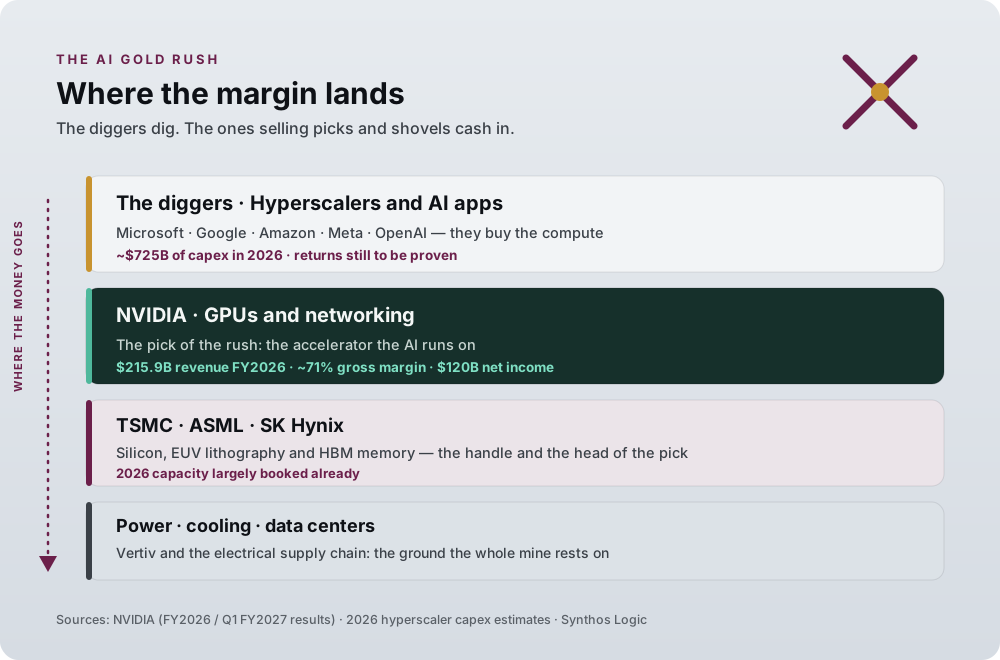
NVIDIA, the pick of the rush
NVIDIA's numbers describe the tool seller in its purest form. In fiscal 2026 the company posted revenue of $215.9 billion, up 65% year over year, with net income near $120 billion and a gross margin around 71%. Put plainly: of every dollar of sales, roughly seventy cents remain as margin before operating expenses. That is the margin of the company selling the indispensable tool, on its own terms.
The most recent quarter confirms the trajectory. In the first quarter of fiscal 2027, ended 26 April 2026, revenue reached $81.6 billion, up 85% year over year. The data center division alone accounted for $75.2 billion, 92% of the total, with the networking piece up 199%. NVIDIA sells the pick the whole of AI runs on, and demand moves faster than the capacity to serve it.
Below NVIDIA, a whole supply chain of tools
The pick, though, needs a handle, a head and a blacksmith. Below NVIDIA sits a second layer of tool sellers, each one owning a bottleneck.
There is TSMC, which physically manufactures the chips for almost everyone — NVIDIA included — and holds roughly 68% of the world foundry market. There is ASML, the sole maker of the extreme-ultraviolet lithography machines required to print the most advanced chips, with an order backlog that gives it years of revenue visibility. There is SK Hynix, which with high-bandwidth HBM memory has already booked much of its 2026 production capacity. And there is the power and cooling supply chain, from Vertiv downward, providing the electricity and the heat removal as rack densities climb past a hundred kilowatts.
Each of these players sells a tool that stays hard to replace, and sells it to people who have to dig anyway. The shared trait is the same: they cash in today, with wide margins, whatever the final outcome of the rush turns out to be.
The diggers dig, and pay upfront
On the other side stand the diggers. The hyperscalers — Microsoft, Google, Amazon, Meta — have announced capital spending of around $725 billion for 2026, up 77% from the already record $410 billion of 2025. Amazon is aiming near $200 billion, Google between $175 and $185, Meta between $115 and $135, Microsoft between $110 and $120. That pushes capex to between 45% and 57% of these companies' revenue, against 10-15% just five years ago.
Here the contrast with the tool sellers turns sharp. The spending is certain and immediate; the return remains a bet. Sequoia put at roughly $600 billion a year the revenue that would be needed to justify the overall spend, and that gap keeps widening. OpenAI projects a loss near $14 billion for 2026, with positive cash flow expected around 2028. AI-linked cloud revenue is real and growing fast — Azure's AI business runs at an annualized rate of tens of billions, rising sharply — yet revenue growth still trails the scale of the spending commitments. This is precisely the prospector's position: invest everything today, and wait for the vein to pay off tomorrow.
What it means for those leading the transformation
The takeaway for a company runs deeper than a tip to buy shares in the shovel sellers. The lesson is about where value accumulates along the AI stack, and therefore where it pays to hold margin and expertise.
The certain value, today, sits in the downstream infrastructure layers, where scarcity is real and suppliers set the terms. The uncertain, potentially enormous value sits upstream, in the applications that still have to prove their return. For anyone building applied AI the practical consequence is plain: durable advantage is won close to the customer's problem, on proprietary data and on the workflow, where the margin depends on the usefulness produced more than on the scarcity of a component. It is the same logic behind reasoning in layers, from silicon up to the application, as the Technology Stack framing does: understanding which layer captures the margin helps in choosing which layer to play on.
What to do now
A few pointers hold regardless of market moves. It pays to read your own AI spend through the prospector's lens: separate the certain, immediate part of infrastructure costs from the expected return, and set in advance the thresholds beyond which a project gets re-examined. It pays to hold what stays scarce and proprietary — the data, the processes, the operational knowledge — because that is where value is retained, more than in the base model, by now a commodity many can buy. And it pays to treat infrastructure suppliers the way you treat any bottleneck: with contracts that guard against lock-in and a plan for portability across vendors and environments.
The open question
The gold-rush anecdote has a known ending: the fever passed, many prospectors were ruined, and the tool sellers consolidated fortunes. The AI story is still midstream. Infrastructure spending is real and produces real profits today; the question the Is AI Profitable Yet? project keeps open concerns the diggers, the ones using those tools to dig. The vein of gold — applications that generate steady value and repay hundreds of billions of capex — how deep does it run, and how soon will the diggers start pulling it out on a regular basis?
Sources
- "NVIDIA Announces Financial Results for Fourth Quarter and Fiscal 2026" — NVIDIA Newsroom, 25 February 2026
- "NVIDIA Announces Financial Results for First Quarter Fiscal 2027" — NVIDIA Newsroom, 20 May 2026
- "Google, Microsoft, Meta, and Amazon capex spending to hit $725 billion in 2026" — Tom's Hardware, 2026
- "Big Tech's $700 billion AI spending spree has no clear end in sight" — Fortune, 30 April 2026
- "ASML investors bet on 'picks and shovels' of AI revolution" — Reuters / Investing.com, 2026
- "Top AI Chip Manufacturing Stocks: TSMC, ASML, and Advanced Chipmaking" — BingX Academy, 2026
- Is AI Profitable Yet? — independent tracking project