What Microsoft announced
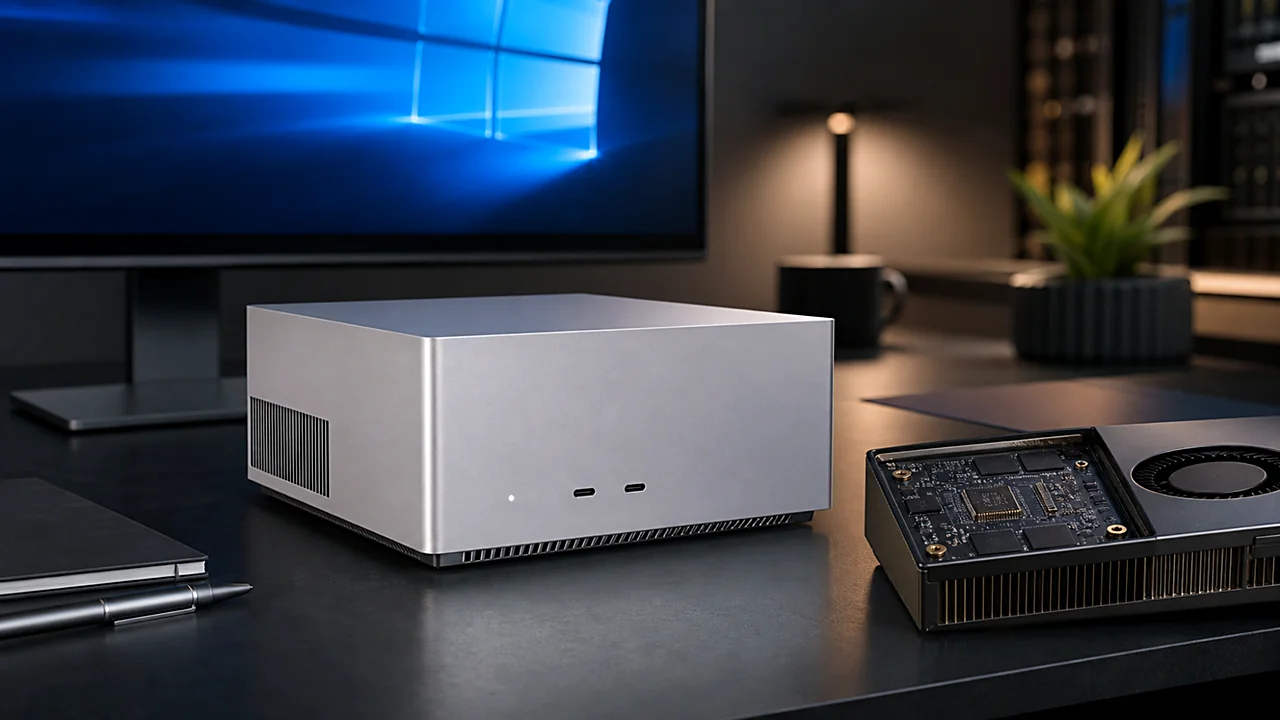
At Build 2026 Satya Nadella unveiled Surface RTX Spark Dev Box, the first Surface-branded mini PC designed for local AI development. It is a compact desktop machine built around the NVIDIA RTX Spark superchip, engineered to sustain AI workloads that run longer and heavier than anything a laptop handles comfortably.
The strategic frame is explicit: Microsoft talks about “local-first AI development” and is preparing Windows for agentic scenarios where software agents execute complex tasks directly on the PC, with the cloud as an extension instead of a mandatory stop. The dev box is the tool developers are supposed to use to arrive ready for that world.
The specifications that matter
The heart of the system is the RTX Spark superchip, developed with NVIDIA: a Grace CPU with 20 ARM cores paired with a Blackwell RTX GPU carrying 6,144 CUDA cores. The platform declares up to one petaflop of AI compute, 128 GB of unified memory and the ability to run models of up to 120 billion parameters locally.
The most interesting technical figure, though, is the thermal headroom: the system is designed to operate within a sustained 100 W envelope, well beyond what ultrathin laptops carrying the same chip allow. The difference shows up in the use cases that matter most to developers: long training runs, local model fine-tuning, agentic pipelines running for hours. In those scenarios sustained performance beats peak performance — and that is precisely where a compact desktop wins over a laptop.
A machine born for developers
The dev box ships with Windows 11 Pro preconfigured at image level for development: Developer Mode enabled, PowerShell 7 as the default shell, WSL 2 with GPU passthrough and CUDA support already configured, plus Visual Studio Code, GitHub Copilot, Git, Python and Node.js preinstalled. The declared goal is to shrink the time between power-on and prototyping, especially for people working across Linux tools, Python stacks and GPU-accelerated libraries.
The design speaks the same language: an anodised, 3D-printed aluminium chassis with a top grid of 1,000 vents, a symbolic nod to the 1,000 declared teraflops. The ports — two USB-C, USB-A, HDMI, Ethernet, audio jack — confirm the dev-box format, ready to be wired to a monitor, a keyboard and a cabled network.
The market context
Surface RTX Spark Dev Box enters a category that is getting crowded fast. The same superchip arrives in the Surface Laptop Ultra, presented the day before, and in third-party mini PCs such as the one announced by Lenovo. The European press — from heise to Notebookcheck — reads the move as Microsoft’s answer to Apple’s Mac Studio, which has so far dominated the niche of compact workstations with abundant unified memory.
The underlying bet is bigger than any single product: moving a meaningful share of AI development from the cloud to the desk. The AI mini PC stops being a conference demo and becomes a work machine built to stay on under real loads.
What it means for teams building in Europe
The launch starts in the United States, exclusively on the Microsoft store, later this year, with a waiting list already open; pricing remains to be announced. Europe, for now, watches — and that window of time can be used well.
For European teams, local AI carries value beyond convenience: it means prototyping with data that stays on premises. In regulated environments — GDPR, the AI Act, NIS2 — the cycle of “prototype locally, scale to cloud once the perimeter is clear” reduces exposure in the most delicate phases, the ones where datasets and models change daily. A machine with 128 GB of unified memory, able to serve open-weight models in the 70-120 billion parameter range, covers a substantial share of today’s enterprise experimentation, with a fixed, predictable cost in place of a variable cloud GPU bill.
What to do now
Four moves that apply regardless of the vendor you choose. Map the AI workloads that would benefit from local execution: fine-tuning open-weight models, inference on sensitive data, building and testing agentic pipelines. Compare the total cost of a dedicated machine with your annual spend on cloud GPU hours for the same loads — break-even arrives sooner than many expect. Audit internal skills on CUDA, WSL and accelerated Python toolchains, which remain the prerequisite for exploiting this class of hardware. Track pricing and the European calendar, while evaluating the alternatives already on the market with the same superchip.
The open question is timing: how long will the American exclusive last, and at what price will the machine reach Europe? If the AI mini PC category keeps its promises, the centre of gravity of experimentation will progressively shift toward the desk — and whoever prepares workloads, skills and business cases ahead of time will start with an advantage.
Sources
- “Building the next generation of devices for developers: Surface RTX Spark Dev Box” — Microsoft Devices Blog, June 2, 2026
- “Microsoft debuts Surface RTX Spark Dev Box — Nvidia-powered mini-PC helps devs get ready for an agentic Windows” — Tom’s Hardware, June 2026
- “Microsoft svela Surface RTX Spark, il mini PC per l’AI” — Tom’s Hardware Italia, June 3, 2026
- “Surface RTX Spark Dev Box: Microsoft’s ‘Dream Machine’” — heise online, June 2026
- “Microsoft reveals new Mac Studio rival with Nvidia RTX Spark and 128 GB RAM” — Notebookcheck, June 2026
- “Microsoft is making a Surface mini PC for AI developers” — Windows Central, June 2026
- “Surface RTX Spark Dev Box” — Microsoft, 2026